Progressive Muscle Relaxation According to Jacobson in Pain Therapy
Gentle Support for Pain Relief, Stress Reduction and Physical Relaxation
Progressive Muscle Relaxation according to Jacobson is a well-established relaxation method that can play an important role in pain therapy. It is used to reduce muscular tension, calm the nervous system and improve the way patients cope with acute and chronic pain. This method is especially helpful for people who suffer from back pain, neck pain, headaches, migraine, muscle tension, sleep problems, anxiety or stress-related physical complaints.
In pain therapy, Progressive Muscle Relaxation is often used as a supportive treatment alongside medical care, physical therapy and other therapeutic approaches. It is simple, safe and can be learned by patients of almost all ages.
What Is Progressive Muscle Relaxation According to Jacobson?
Progressive Muscle Relaxation, often called PMR, was developed by the American physician Edmund Jacobson. The method is based on a simple principle: when muscles are deliberately tensed and then consciously relaxed, physical tension decreases and the whole body begins to calm down.
The patient systematically tenses different muscle groups for a few seconds and then releases the tension. By comparing tension and relaxation, the body learns to recognize hidden muscular stress and let it go more effectively.
This process not only relaxes the muscles, but also has a positive effect on breathing, heart rate, inner restlessness and the overall stress response of the body.
Why Is Progressive Muscle Relaxation Helpful in Pain Therapy?
Pain and muscle tension are often closely connected. Many patients with chronic pain unconsciously tense their muscles for long periods of time. This may worsen pain and create a cycle of discomfort, stress and further tension.
Progressive Muscle Relaxation may help to:
- reduce muscular tension
- calm the nervous system
- lower stress levels
- improve body awareness
- reduce the intensity of pain
- improve sleep
- reduce anxiety related to pain
- increase physical and emotional relaxation
Because stress and tension can increase the perception of pain, regular relaxation training may significantly improve a patient’s quality of life.
How Does Progressive Muscle Relaxation Affect Pain?
Pain is not only a physical sensation. It is also influenced by emotional stress, anxiety, exhaustion and mental tension. When the body remains in a constant state of stress, muscles stay tight, circulation may worsen and the nervous system becomes more sensitive.
Progressive Muscle Relaxation may support pain therapy in several ways:
1. Reduction of muscle tension
Tight muscles often contribute to neck pain, shoulder pain, back pain and tension headaches. Releasing this tension may reduce pain directly.
2. Calming of the autonomic nervous system
Relaxation can shift the body away from stress mode and toward a calmer, more balanced state.
3. Better control over pain perception
Patients often feel less helpless when they learn a technique they can use actively to influence their symptoms.
4. Improvement of sleep and recovery
Poor sleep often makes pain worse. Relaxation before bedtime may improve sleep quality and support recovery.
5. Reduction of stress-related pain amplification
Stress, fear and constant inner tension may increase pain intensity. Relaxation helps interrupt this cycle.
Which Conditions May Benefit From Progressive Muscle Relaxation?
Progressive Muscle Relaxation is commonly used in pain therapy for:
- chronic back pain
- neck and shoulder pain
- lower back pain
- tension headaches
- migraine
- fibromyalgia
- muscle tension
- joint pain
- nerve-related pain
- phantom pain
- temporomandibular joint tension
- stress-related pain disorders
- pain associated with anxiety
- sleep problems related to chronic pain
It may also be useful for patients recovering from illness, surgery or physical exhaustion.
Progressive Muscle Relaxation for Back Pain
Back pain is one of the most common reasons for using Progressive Muscle Relaxation. People with back pain often develop chronic tension in the neck, shoulders, upper back and lower back. This ongoing tension may worsen pain and reduce mobility.
Regular practice may help:
- loosen tight muscles
- reduce pain intensity
- improve posture awareness
- increase mobility
- reduce stress-related tightening of the back muscles
For many patients, relaxation becomes an important part of long-term back pain management.
Progressive Muscle Relaxation for Neck Pain and Headaches
Neck pain and tension headaches are frequently caused or worsened by stress and muscular tightness. Patients who sit for long hours, work under pressure or grind their teeth often carry tension in the neck, jaw and shoulder region.
By learning to relax these muscle groups, patients may experience:
- less neck stiffness
- fewer tension headaches
- reduced pressure in the head
- improved mobility
- greater inner calm
This may also be beneficial for some patients with migraine, especially when stress is a major trigger.
Progressive Muscle Relaxation for Chronic Pain
Patients with chronic pain often live in a constant cycle of pain, tension, poor sleep and emotional stress. Over time, this may make the nervous system more sensitive.
Progressive Muscle Relaxation may help patients with chronic pain by:
- creating regular physical relaxation
- reducing the body’s stress response
- improving coping strategies
- supporting emotional balance
- increasing the feeling of control over symptoms
Although relaxation may not remove the underlying cause of pain, it can significantly improve the daily experience of living with pain.
Progressive Muscle Relaxation for Anxiety and Sleep Problems
Chronic pain is often linked to anxiety, inner restlessness and poor sleep. Patients may worry about worsening symptoms, movement, work ability or future pain episodes.
Progressive Muscle Relaxation can be especially useful because it helps both body and mind slow down. Regular practice may:
- reduce inner tension
- calm racing thoughts
- support sleep onset
- improve sleep quality
- reduce anxiety associated with pain
This makes it a valuable supportive technique in holistic pain therapy.
How Is Progressive Muscle Relaxation Performed?
The exercise is usually done in a quiet and comfortable position, either lying down or sitting. One muscle group after another is gently tensed for a few seconds and then relaxed.
Typical muscle groups include:
- hands
- arms
- shoulders
- face
- jaw
- neck
- chest
- abdomen
- back
- buttocks
- legs
- feet
The patient focuses on the sensation of tension and then on the feeling of release. Over time, this improves awareness of hidden tension and helps the patient relax more quickly in daily life.
A full session may last between 10 and 30 minutes, depending on the method used.
What Does a Session Feel Like?
Most patients describe Progressive Muscle Relaxation as:
- calming
- pleasant
- grounding
- physically relieving
- mentally soothing
Some patients notice warmth, heaviness or a feeling of quietness in the body. Others feel sleepy or deeply relaxed after practice. These reactions are normal.
How Often Should It Be Practiced?
For best results, Progressive Muscle Relaxation should be practiced regularly. Many patients benefit from:
- daily practice
- short exercises once or twice a day
- relaxation before sleep
- relaxation during stressful periods
- regular use during chronic pain treatment
The more often the method is practiced, the easier it becomes for the body to relax.
Advantages of Progressive Muscle Relaxation in Pain Therapy
Progressive Muscle Relaxation offers many benefits:
- non-invasive
- no medication required
- easy to learn
- safe for most patients
- suitable for home practice
- helpful for stress, anxiety and sleep
- can be combined with medical treatment
- supports long-term pain management
It is particularly valuable because patients can continue using it independently after learning the technique.
Are There Any Limitations?
Progressive Muscle Relaxation is very safe, but it does not replace medical evaluation or treatment. Sudden, severe or unexplained pain should always be examined by a doctor.
Some patients with severe acute pain, certain neurological conditions or major psychiatric disorders may need a modified approach. In these cases, relaxation training should be adapted individually.
Progressive Muscle Relaxation as Part of a Holistic Pain Therapy Concept
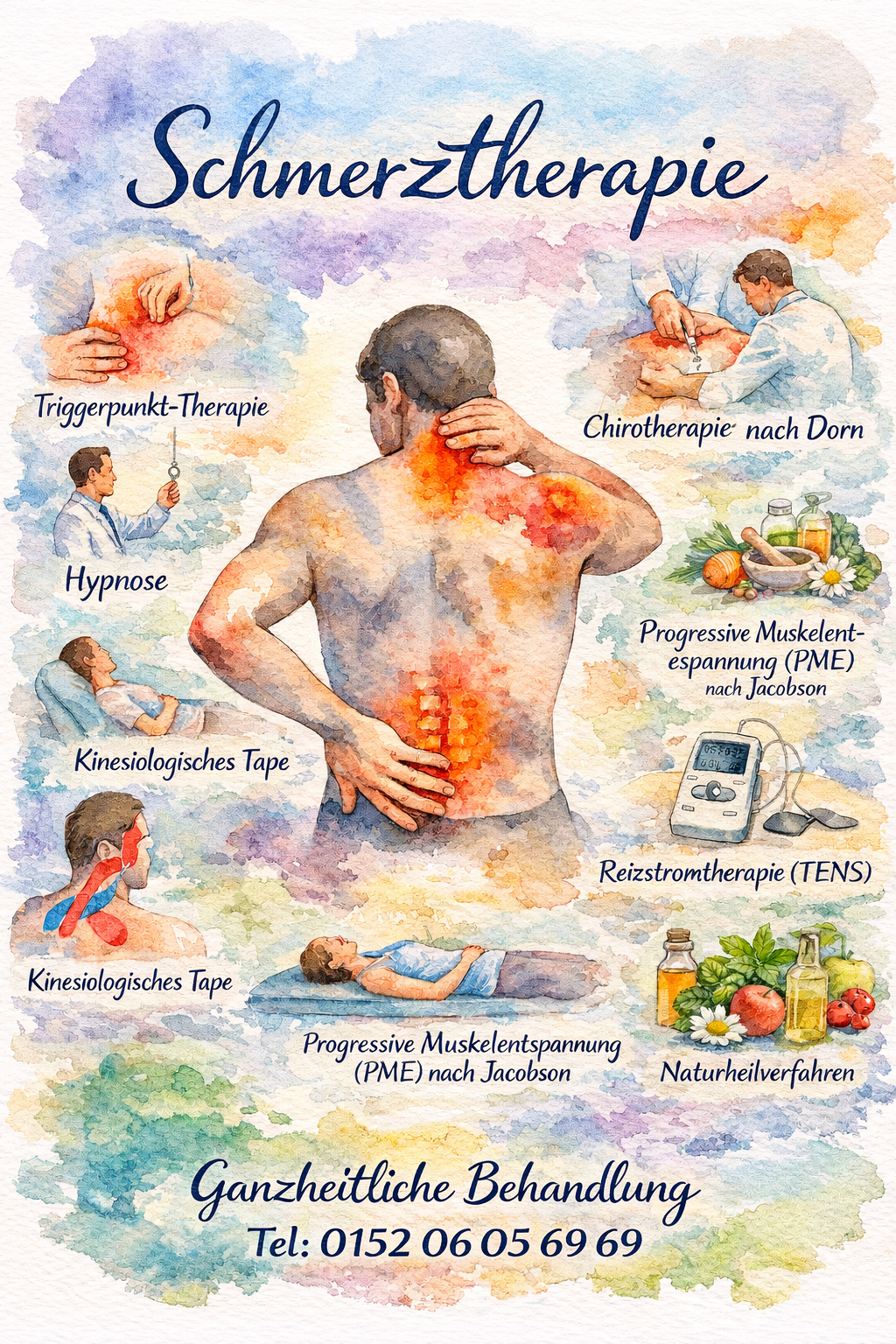
In modern pain therapy, the best results are often achieved by combining different treatment methods. Progressive Muscle Relaxation may be combined with:
- medical pain treatment
- physical therapy
- manual therapy
- trigger point therapy
- neural therapy
- breathing exercises
- psychotherapy
- hypnosis
- lifestyle and stress management
This integrative approach helps address pain from both a physical and emotional perspective.
Progressive Muscle Relaxation During a Private Medical Home Visit
As part of a private medical home visit service, relaxation methods such as Progressive Muscle Relaxation may be recommended as supportive treatment for patients with pain, stress-related complaints and chronic muscular tension.
This may be especially useful for:
- patients with chronic pain
- elderly patients
- patients with limited mobility
- patients with stress-related symptoms
- patients who prefer treatment in the comfort of their own home
Private medical home visits in Frankfurt am Main, Mainz, Wiesbaden and throughout the Rhine-Main region allow patients to receive individual medical support in a calm and familiar environment.
Available 24 hours a day.
Telephone: 015206056969
Please note: This information is intended for general educational purposes only and does not replace a personal medical consultation, examination or treatment.